Electric moped battery: more range, safer charging, and riding through winter
What range to expect, the charging habits that keep a battery healthy, and the fire rules every rider should know.
How do I get the most range from an electric moped battery?
Ride smoothly, keep tyres at the right pressure, avoid running the battery flat, and in winter keep the battery indoors and plan for noticeably less range — manufacturers quote anything from about 10% to 30% less on cold days. Never charge a battery below freezing or straight after a hard shift: let it reach room temperature first.
Charge only with the official charger, never overnight unattended and never in a hallway or escape route. London Fire Brigade attended a record 206 e-bike and e-scooter fires in 2025, most linked to poor-quality batteries, conversion kits and wrong chargers.
What range to expect
Rated range is measured in kind conditions. On a delivery shift — stop-start traffic, a loaded box, hills, cold — expect less. Plan your shift on the real figure, not the brochure one.
| Vehicle | Rated range | Battery |
|---|---|---|
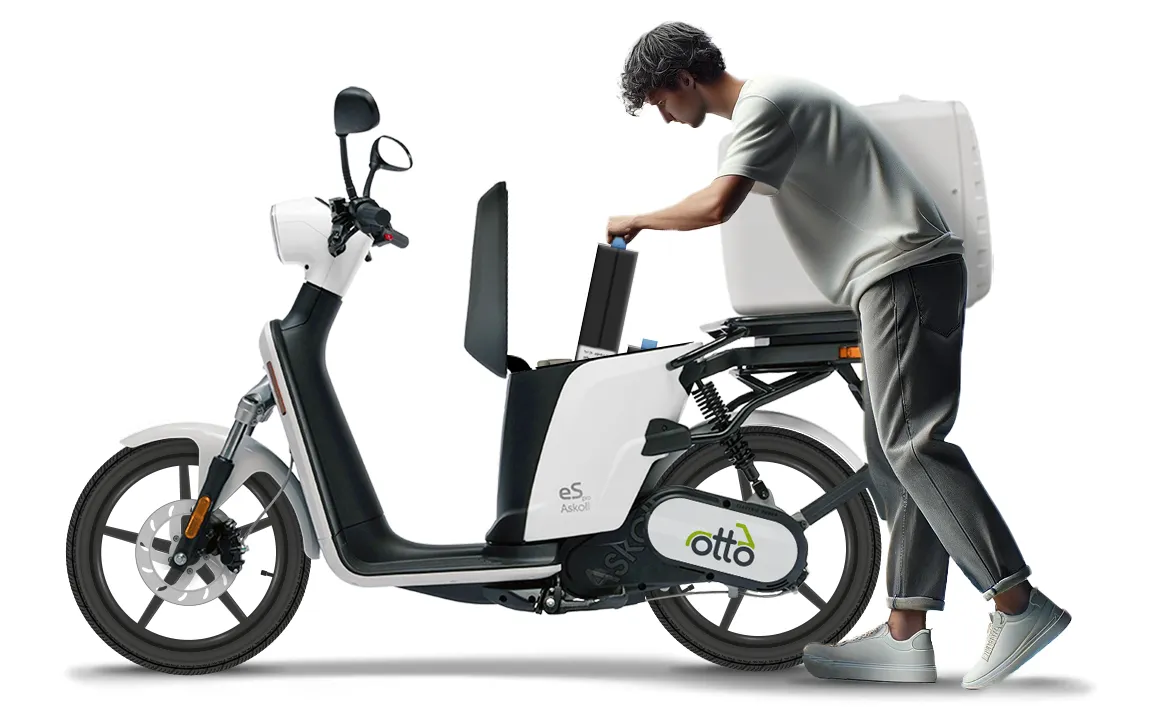
| Askoll eSPro 70 (moped) | About 40 miles | 2 × 1.3 kWh, removable |
| Super Soco CPx (moped) | Up to 65 miles | 2, removable |
| ETT Trayser 2.0 (e-bike) | 50–75 miles | 1,056 Wh, removable |
| Cycl Carr-E (e-bike) | About 40 miles | Removable |
Removable batteries are the real advantage. The Askoll’s two packs swap in under 10 seconds; the e-bike packs take about 4 hours to charge. You charge them at home from a normal 3-pin socket — about £5 a week of electricity for a full-time rider — and you never need a charging point on the street.
Habits that add miles
Range is mostly decided by how you ride and how you look after the bike:
- Smooth throttle, early braking. Hard launches from every light burn energy; rolling up to red lights lets regenerative braking put some back.
- Tyre pressure. Soft tyres can cost real range and make the bike vague in the wet. Check them weekly.
- Weight. Empty the box of what you don’t need. A full drinks order is weight enough.
- Eco mode in town. Below 30 mph you rarely need full power; save it for the A-roads.
- Don’t run it to zero. Lithium batteries last longest kept roughly between 20% and 80%. Topping up is fine — there is no “memory effect”.
- Carry the spare charged. On a twin-battery moped, start the shift with both full and swap before the bike starts limiting power.
Winter range
Cold slows the chemistry inside a lithium battery, so the same charge gives fewer miles. Figures vary — manufacturers quote anything from about 10% to 30% less on cold days — and the battery recovers once it warms up again. The loss is temporary; charging a frozen battery is what does lasting damage.
- Store and charge the battery indoors, at room temperature.
- Never charge a battery that is below 0°C — bring it in and let it warm up first.
- Fit the battery just before you set off, so it starts the shift warm.
- On frosty days, plan your shift on about two-thirds of your summer range, and keep the spare close.
Charging safely: the London Fire Brigade rules
London Fire Brigade attended 206 e-bike and e-scooter fires in 2025 — a record, up from 171 in 2024 — and two people died. The Brigade names poor-quality batteries, DIY conversion kits and wrong chargers as the main causes, and says gig riders in particular need to know the risks. Its #ChargeSafe advice:
- Use the correct, official charger from a reputable seller — never a cheap marketplace replacement.
- Let the battery cool after a ride before you charge it.
- Unplug when charging is finished; don’t charge while you sleep or when you’re out.
- Never store or charge a battery in a hallway, stairwell or anywhere that blocks your way out.
- Fit a smoke alarm where you charge, and test it.
- Stop using a battery or charger that gets very hot, smells, or changes shape.
- No DIY conversion kits. If a battery catches fire: get out, stay out, call 999.
Illegal e-bikes: the fire risk and the seizure risk
A legal e-bike (EAPC) has a motor of up to 250 W and stops assisting at 15.5 mph. Anything more powerful — or with a throttle that drives the bike above that speed — is legally a motor vehicle: it needs registration, insurance and a licence, and without them it can be seized. Since 29 June 2026 police no longer have to give a warning before seizing a vehicle being used anti-socially, and the Met has been seizing illegal e-bikes in record numbers.
Many of the London fires start with exactly these bikes: converted frames and unbranded batteries. A road-legal electric moped on hire-and-reward insurance, or a certified e-bike, removes both risks. See our legal e-bikes or electric mopeds.
Out of charge mid-shift?
Otto riders can swap a flat battery for a charged one for free at the Hammersmith workshop, 66 Paddenswick Road, W6 0UB, Monday to Friday 9:00–18:00. If the bike itself is the problem, use the problems procedure — in most cases we replace it the same day.